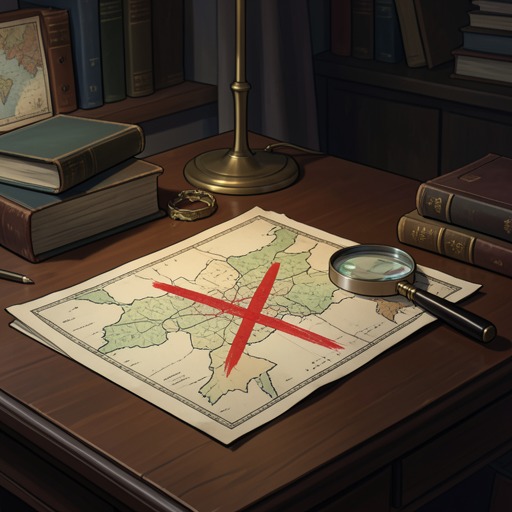
Pop Merrill's treasure map
Needful ThingsPop Merrill's treasure map is the small, practical-looking guide that turns Ace Merrill's hope of escaping his debts into a pursuit of buried wealth, then reverses that promise at the old Camber place. Its crosses seem to offer a reliable code: two caches have already been found beneath flat stones. But the map's most important mark leads not simply to treasure, but to evidence that Alan Pangborn had discovered the same cache first and left Ace a personal warning in its place.
Marks, Stones, and the Promise of Treasure
Ace studies the brown-paper map after concluding that the crosses must signify something more valuable than the moldy trading stamps he has already encountered. Two earlier caches were located where the marks indicated, each beneath a large, flat stone. The pattern gives him a working equation—crosses and flat stones mean buried treasure—and persuades him that Pop Merrill had hidden substantial wealth, possibly gold, currency, or negotiable securities. The six rolls of steel pennies Ace found at the old Masters farm, worth at least six hundred dollars, reinforce the belief that the clues point to real valuables, even if they are not themselves a fortune.
The map's marks do not make Ace cautious; they sharpen his appetite. After snorting the rest of the cocaine Leland Gaunt had supplied, he returns to the book containing the map and reads its evidence more hopefully. The crosses now seem to add up to a clear promise. That confidence rests on a pattern Ace has observed, but it also keeps him from asking whether the map's apparent consistency might conceal a trap.
The Camber Place and the False Cache
As Ace traces the brown-paper map, the old Joe Camber place draws his attention because it is the only location where two crosses lie close together. He studies the pair, and their proximity makes the property seem especially promising. At five o'clock, he drives into the Camber dooryard with the map in his back pocket. Leland Gaunt has thoughtfully provided a pick and shovel, and Ace brings them to the leaning, overgrown porch to examine the marks before digging.
The hunt has become a stimulant in its own right. The short-term effects of cocaine have worn off, but Ace's heart is still beating briskly as he looks over the weedy yard, sagging barn, and sunflowers. He imagines that the place will let him leave the Flying Corson Brothers behind and get rich at the same time. The map is no longer merely a record of Pop's hiding places: in Ace's mind, it is the route out of his immediate predicament.
The first cache at the Camber property disappoints him. Ace finds a Crisco can and, on opening it, discovers trading stamps rather than the wealth he expects. He angrily throws the stamps aside, searches the can for anything concealed at the bottom, and kicks it away. The discovery does not make him abandon the map. In a brief panic, he checks that he still has it; then he sees that the other cross lies behind the barn and forms a new explanation for the useless cache.
Bait, Switch, and Alan's Letter
Ace decides that the Crisco can was a blind: Pop may have anticipated that someone would recognize his practice of marking caches with flat stones, and placed a worthless stash where it would misdirect a treasure hunter from a second, less obvious one. Because Ace has the map, he believes he can defeat the deception. He takes the pick and shovel and races toward the barn, treating the second cross as the key to the real prize.
The second hiding place contains no fortune. Inside is a white envelope. Ace tears it open; a folded sheet and a smaller envelope fall out, and he reads the typed note addressed to him before attending to the other envelope. Its opening makes the map's trail personal: Alan Pangborn says he cannot be sure Ace will find the message, jokes about Ace's time in prison, and recalls visiting Pop regularly. Alan says he and Pop had an arrangement: Pop paid him one hundred dollars a month, and Alan let the illegal lending continue.
Alan explains that, during one visit, Pop left his desk unlocked while going to the toilet. Alan looked inside and found the map. One cross—the one marking the Camber location—was red. After Pop's death, Alan came to the property and dug up the Crisco can himself. It had contained more than two hundred thousand dollars. Rather than leave that money for Ace, Alan says he decided to share it by leaving Ace exactly what he deserved: the letter. The apparent treasure hunt has thus led Ace to the record of a prior discovery and to the revelation that Alan took the money.
What the Map Leaves Behind
Alan's postscript turns the letter into a direct warning. He tells Ace to accept the situation and forget the money, invoking finders keepers; if Ace tries to confront him over Pop's fortune, Alan threatens him. The message gives Ace no treasure and no neutral explanation of the cache: the map has brought him face to face with Alan's deliberate appropriation and an explicit threat against pressing the matter.
The map's changing meaning is central to its force. First it appears to be an intelligible system, with crosses and flat stones confirmed by earlier finds. At the Camber place, the worthless can suggests a hidden second layer of deception; the envelope then reveals that the decisive deception occurred before Ace arrived. Alan has already used the map to locate the money, and Ace's possession of the clue cannot undo that advantage. What began as a promise of wealth ends as proof of how thoroughly the treasure has escaped him.